
The Common Garden
Why a Common Garden study?
For many decades, human beings have argued whether nature or nurture is more influential. Through a common garden study, we aim to offer at least some answers to this question for grapes. The common garden experiment we have established allows us to assess the inherent properties of genetically diverse vines in response to common environmental conditions. We have learned, for example, that Carignane is an extremely vigorous grower that requires abundant pruning. That Syrah and Shiraz, though technically the same grape, behave quite differently under our common garden conditions. We have identified distinctive and characteristic flavor profiles for specific varieties that can only be attributed to varietal differences, since the terroir for all of our grapes is identical.
We think it’s fun and fascinating to compare wines from vines where variety is the sole independent variable. Some grapes produce elegant, restrained, complex wines, such as Petit Verdot, a sometimes “difficult” grape that is a favorite of Donnette Thayer, one of one of our founders. Some produce friendly, engaging, pizza-ready wines, like our Sangiovese, which is also a friendly vine and strong producer. Our signature grape, Cabernet Franc, is a rather perverse grape that grows well almost everywhere, but only rarely produces decent wine. A good Cabernet Franc has been described as aromatically explosive, with a dried herb fragrance that displays a natural power and energy that can rival the most flavorful wines, exemplified by Cabernet Sauvignon. A poor Cabernet Franc will overproduce 3-isobutyl-2-methoxypyrazine (IBMP), leading to descriptions of “cattle barn” or “old garbage” for this wine. We have been pleased with the results of wines from our Cabernet Franc grapes, which fall squarely into the aromatically explosive category.
| Variety | Clones | Variety | Clones |
|---|---|---|---|
| Aglianico* | 1, 4, 5 | Marsanne* | 3 |
| Albarino* | 1 | Mourvedre | 2, 4 |
| Alicante Bouschet* | 2 | Nebbiolo | 1, 9 |
| Alvarinho* | 1, 3 | Negro Amaro | 1 |
| Assyrtiko* | 1, 2 | Nero D’Avola* | 2 |
| Barbera | 5, 6 | Roussanne* | 4, 5 |
| Cabernet Sauvignon | 30, 31 | Sangiovese* | 12, 15, 19, 20, 21, 23 |
| Carignane* | 3, 10, 11 | Sauvignon Blanc | 1, 23, 29 |
| Cinsaut | 3, 4, 5 | Shiraz* | 9 |
| Counoise | 2.1 | Syrah | 15 |
| Durif* | 4, 6 | Tannat | 4 |
| Falanghina* | 1 | Tempranillo | 3 |
| Fiano* | 1, 2 | Touriga Nacional* | 1, 3, 5 |
| Gamay Noir | 6, 9 | Verdejo* | 2 |
| Garnacha Tinta* | 1, 3 | Verdelho* | 6, 10, 11 |
| Macabeo* (Viura) | 568 | Viognier | 2 |
| Malbec | 22, 31 | Viura* (Macabeo) | 1 |
| Malvasia Bianca | 3 | Zinfandel* | 3, 42, 43, 44 |
Layout
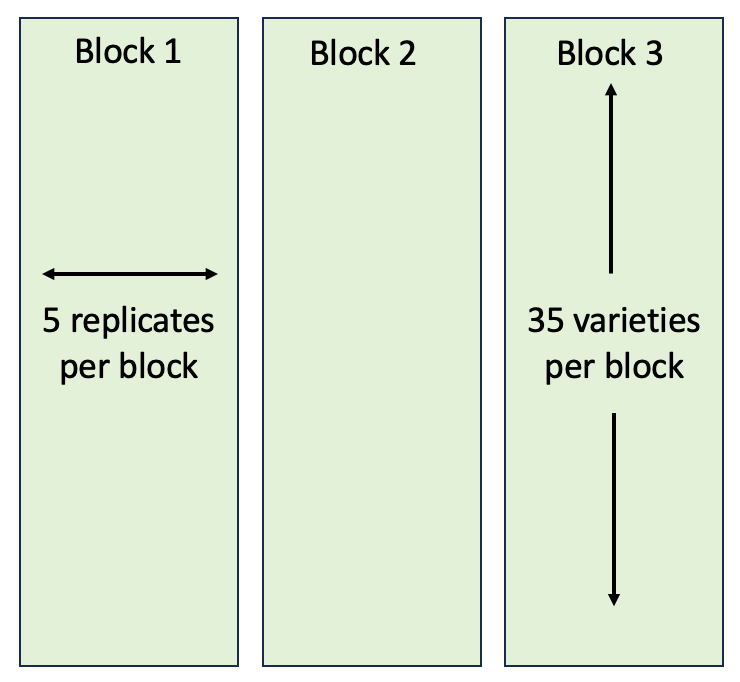
Layout of the common-garden experiment, showing experimental blocks to be given contrasting irrigation treatments. Each block contains 35 grape varieties, and each row contains 5 plants per block.
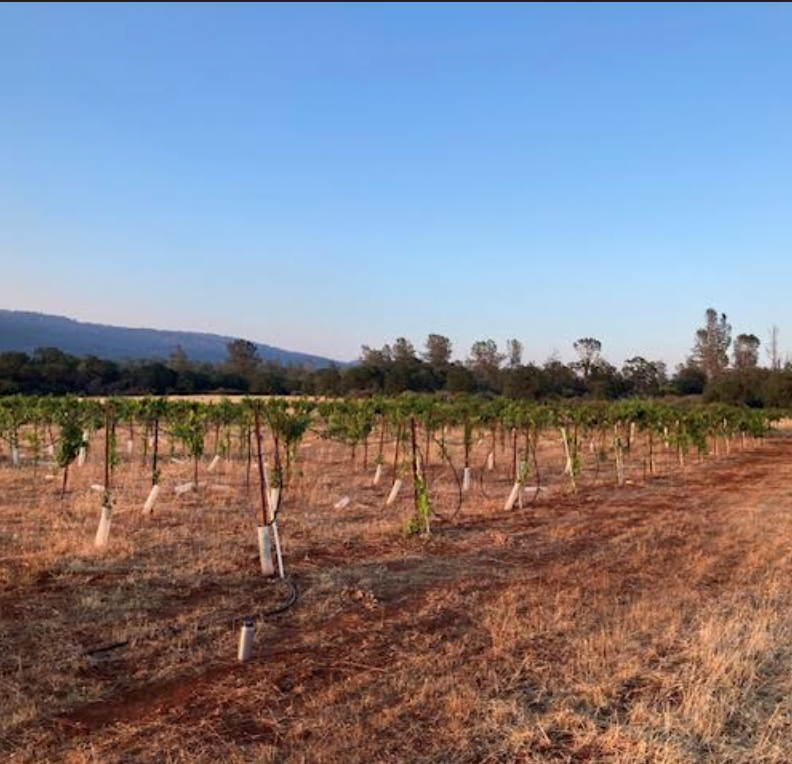
View of experimental bocks in June 2023, about 2 years after initial planting. Most plants are now 1.5m tall and many have started to produce fruit.